What’s the big deal? Marijuana and THC products are now legal in Virginia, right? The legal answer to that is—”well, sort of.” Whether you are a Vape shop owner, vape shop employee, vape shop customer, THC consumer, or just THC curious, this article will interest you.
The genesis for this Article is that our firm McCormack and McCormack has seen about a 500% increase in criminal cases stemming from or connected to local Vape Shops over the last 24 months or so. Most, if not all of them, contained some element of confusion regarding what was legal and what was not.
So, let’s walk through things from the beginning.
Marijuana Decriminalization in Virginia
Beginning in the Summer of 2020, Marijuana possession in Virginia began shifting away from its original status as a misdemeanor criminal offense. At first, it changed into an unclassified misdemeanor with a maximum jail sentence of 30 days, then it took a brief stop as a decriminalized “civil offense” punishable only by a fine, and then finally it has arrived at its current legal status which is possession of limited quantities for personal use is legal.
The double emphasis on possession is intentional. The key here, and the terms you see used over and over, are possession and personal use quantities. One can quickly see the problem that this created. The sale and distribution of traditional Marijuana remains illegal, as does possession of more than one ounce. This is also a distinct legal status pertaining to traditional marijuana because THC-variant products like Delta 8 can have an entirely different legal status, as discussed below.
Not all Marijuana Related Activities have been legalized
The possession of traditional marijuana, up to one ounce, is permitted in Virginia, but public smoking remains prohibited. If a person possesses more than one ounce, is distributing, or is in possession of quantities or packaging that suggests an intent to distribute, the person can be charged with misdemeanor or felony offenses for possession with intent to distribute, or distribution or marijuana. Virginia Code section 18.2 -248.1 makes the sale, distribution, or possession with intent to sell or distribute a class 1 misdemeanor if less than one ounce of marijuana is involved, a class 5 felony if between one ounce and five pounds is involved, or much more serious felony if more than five pounds is involved.
Limitations also exist if a person chooses to grow personal-use marijuana plants. If the person exceeds the legal maximums they can be criminally charged. Specifically, in one’s residence, up to four marijuana plants are permitted, but must be tagged with the owner’s identification and shall not be manufactured for sale (Virginia Code § 4.1-1101). Violation of this code may result in a felony charge depending on the quantity of marijuana plants.
To further cloud this issue, although a person is legally permitted to plant and cultivate up to four seeds/plants in Virginia, it remains illegal to purchase the seeds in Virginia.
THC Variants “Delta 8” “Delta 9”
For anyone that does not know, Delta 8, Delta 9, and synthetic cannabinoids involve commercially synthesized products derived in some form from the marijuana plant, including hemp and CBD derivatives. For purposes of this article, this category also includes synthetically created products that have been designed to mimic the effects of traditional THC but which have different chemical structures and therefore do not test at a laboratory as traditional marijuana or THC 9.
Just for awareness, many synthetic cannabinoids have been added to the federal controlled substance act. The federal status of THC itself is shifting and will be discussed below, but this Article is about Virginia law.
So what is Virginia doing with these products? Virginia tasked the Virginia Department of Agriculture and Consumer Services to create an Office of Hemp Enforcement. Formed in 2023, the Office enforces the regulatory and legal requirements for the sale of “certain hemp-derived products.”
The phrase “certain hemp-derived products” is the key.
So what can a Vape Shop legally sell and how?
Any hemp product (meaning THC derived product) may not exceed 0.3 percent THC and may not have more than two milligrams of total THC per package unless the CBD to THC ratio is as least 25 parts CBD for every one-part THC.
The measure of THC in this regulation means total THC, including Delta 8 and Delta 9 THC.
Even if the products a store intends to sell meets the above requirements, before any person can legally sell these products, they must submit an Edible Hemp Products Disclosure form to the Office and they may be required to receive a permit unless they can demonstrate that their retail establishment is exempt. Further, beginning in November 2024, the VDACS regulations began requiring that all entities who wish to sell hemp regulated products register with the office. It’s a $1,000 annual fee, and Virginia Code Chapter 41.1 Section 3.2- 4122 pertains.
The seller or vendor who meets all these requirements must still be sure that the products they sell are in compliance and that they do not sell to anyone under the age of 21. Various penalties pertain depending on the specific violation, ranging from civil fines and penalties to criminal charges.
The Federal Transition to Schedule III
In December 2025, President Trump issued an executive order to begin transitioning Marijuana from a Schedule I controlled substance to a Schedule III controlled substances under the Federal Controlled Substances Act. It is important to understand that this executive order does not confirm or establish the transition, rather it only began the process. The transition requires various administrative rulemaking processes to occur, with
both DEA and DOJ involvement. As such, Marijuana has not suddenly become “legal” on the federal side. Similarly, even if this change is successful, a federal move from Schedule I to Schedule III does not equate to legalization. Schedule III controlled substances remain federally illegal for recreational use. A move to Schedule III of the federal Controlled Substances Act would, however, enable medical providers to write prescriptions for THC as a move to Schedule III would denote the federal government’s acceptance that marijuana/THC has accepted medical uses.
Ignorance of the Law Will Not Be an Excuse
Whether you own or manage a Vape Shop, are simply an employee, or you are customer, ignorance of the law will not be an excuse if you are caught in violation. This Article has not attempted to address every legal nuance and situation that can occur, but you can be sure that a person’s excuse or explanation that they did not know about the law will not be persuasive to the police, nor will it prevent their arrest and prosecution.
It is each person’s responsibility to educate themselves on the law and regulations. This is whether you are a store owner, manager, cashier, or customer. If you find yourself involved in an investigation, execution of a search warrant, or otherwise under suspicion, you would be best served to say nothing and contact an attorney. This is regardless of whether you have been provided Miranda warnings by the police or not.
At McCormack and McCormack, we have represented numerous vape store employees, owners, and managers facing criminal charges in multiple jurisdictions across Virginia. If you or someone you know is facing these charges, or you believe your store or employer may be under suspicion or investigation for THC sales, please call McCormack and McCormack at (757)463-7224 for a free legal consultation.
Every criminal case has its unique challenges. Multi-codefendant federal criminal jury trials, however, add additional difficulties and considerations the extend beyond the customary issues that present themselves during a criminal trial.
In April 2024, the trial lawyers of McCormack & McCormack Mr. Jarrett McCormack and Mr. Robert Canoy undertook a two week federal jury trial in an effort to beat the odds. What odds? The odds which indicate that the deck is stacked against the Defense and in favor of the prosecution in federal cases.
In 2023, the Pew Research Center published their conglomeration of statistics from federal criminal cases for fiscal year 2022. Not surprisingly, their research found that for fiscal year 2022, 89.5 percent of those charged with federal crimes pled guilty. That’s right, nearly 90 percent of federal cases charged in 2022 resulted in guilty pleas.
Sometimes fortune favors the bold, but it is not without its risks. According to Pew’s research, of all the federal criminal defendants who went to contested jury trials in 2022, only 0.4% were found not guilty.
These stifling odds also do not take into consideration the unique challenges that occur when a person faces a joint trial in which multiple co-defendants have their fate decided at the same time by the same jury. The challenges with these types of trial are the lack of protections on the use of evidence which is admitted during the trial.
To explain this predicament further, imagine the situation where each codefendant and their counsel have only their own best interest at heart, as expected. Many times this self-interest leads to not only animosity between the codefendants, but an actual situation where one codefendant’s trial strategy relies heavily on placing the blame on another codefendant. This may result in one or more defendants not only defending against the Government prosecutors across the isle but also multiple codefendants sitting at the table next to them. This becomes compounded by the fact that all evidence against all codefendants is received and considered by the same jury—even evidence which has little to do with a particular codefendant. The phrase guilty by association takes on new meaning in these situations. While the Court will provide a standard “spillover” jury instruction, in which the Court attempts to instruct the jury that they must keep the evidence separate and find sufficient proof for each defendant without regard to the other defendants, the effectiveness of this instruction is concerning.
One of the only significant protections that is binding on the federal courts is the Brutonrule for codefendant cases. The Bruton rule began as an absolute bar to admitting a codefendant’s pretrial confessions, admissions, or incriminating statements in a trial with multiple codefendants. At its origin, the rule’s theory was founded in constitutional confrontation clause concerns because a codefendant obviously cannot cross-examine, confront, or otherwise question a codefendant during trial. Through subsequent cases, however, the Bruton rule is now subject to numerous exceptions and work arounds that have diminished its impact in terms of real worldprotections in codefendant trials.
In practice, in preparation for your case, it is helpful to envision the uniqueness of a multiple codefendant jury trial. To that end, several practice tips and pointers may be helpful:
In the pretrial stages of your case, each codefendant will file their own motions. When cases and concepts are not adverse, there is strategically the option to file joint motions, or to join or otherwise adopt a codefendant’s filing. Codefendants counsel have the option to enter into a Joint Defense Agreement (JDA), in which their might be varying amounts of strategic cooperation between codefendants in preparation for trial. When codefendant equities and interest are completely inapposite, such a JDA will likely not be possible. Before trial you will also need to make the determination of whether you want to attempt to sever your case from the group in hopes of achieving your own trial—but the standard to actually have the Court order a severance over the Government’s objection is significant making most severance motions end in a denial.
As trial begins the codefendants will work through jury selection. Each defense counsel will submit proposed voir dire questions which are unique to their case concerns. Many federal judges do not allow any attorney conducted voir dire, so you may be simply proposing questions that the judge will ask the venire. After the judge finishes the voir dire process, counsel will be given the opportunity make challenges for cause. Some judges will require all codefendant counsel to confer and essentially propose joint defense challenges for cause—a situation that could become problematic if there were disagreement.
Similarly, once challenges for cause are decided by the Court, the Government and the Defense will have an opportunity to exercise peremptory challenges. There is no rule basedpolicy on how peremptory are handled in multiple codefendant cases. Instead of dividing the total peremptory challenges amongst each individual codefendant, many judges will require the codefendants to jointly exercise their challenges for cause. What would be the remedy if the codefendants could not agree who to strike? Good question.
As trial proceeds the uniqueness continues. The prosecution will give their opening statement and then each codefendant may give an opening statement—generally in the order in which they were named on the indictment. As witnesses are called by the prosecution, each codefendant has the opportunity—in turn—to question each witness. The order of question, however, is usually set by the standard order of events, meaning you may always be the first (or last) of the defendants to have access to a given witness. Consequently, you have don’t really have a remedy for codefendant eliciting information from a witness which may be helpful to them but very harmful for your client.
All in all, federal multiple codefendant trials present a unique set of challenges and difficulties which are very unique to that practice. In selecting your attorney for this type of case, be sure that you retain counsel which has experience with this very nuanced and specialized area of the law.
To find out more about how we can help, contact our firm online or request a free consultation today.
In Virginia, a person is eligible to secure a Protective Order if, within a reasonable period of time, he/she has been subjected to an act involving violence, force, or threat that results in bodily injury or places the person in reasonable fear of death, sexual assault, or bodily injury. (See Code of Virginia §19.2-152.10).
There are three types of Protective Orders.
1. Emergency Protective Orders (EPO) – A law enforcement officer or the abused person may request an EPO. The EPO is frequently requested by a police officer after an arrest has been made or if the officer finds that there is significant risk of further acts of family abuse, or violence, force or threat. An EPO is issued by a magistrate or a judge and is entered based on the sworn statement of the Petitioner. Once entered, an EPO lasts for 72 hours or until the next session of court, whichever is later. The EPO can impose the following conditions on the respondent:
a. Prohibiting all contacts by the Respondent with the victim or the victim’s family or household members;
b. Prohibiting acts of violence, force, or threat or criminal offenses resulting in injury to person or property;
c. Other conditions the judge or magistrate deems necessary to protect the Petitioner and family/household members;
d. In cases of family abuse, an EPO can also grant temporary possession of the residence to family/household members.
2. Preliminary Protective Orders (PPO) – A person who alleges under oath that he/she has been the victim of family abuse or other acts of violence, force or threat can request entry of a PPO against the Respondent. A PPO can be entered by a judge and will remain valid for a period of 15 days or until the final Protective Order hearing. The Petitioner does not have to have an EPO to get a PPO, and the Respondent is routinely not at the hearing. If a PPO is granted, it will last 15 days, or until the final Protective Order hearing. The PPO can impose the following conditions on the Respondent:
a. Prohibiting all contacts by the Respondent with the victim or the victim’s family or household members;
b. Prohibiting acts of violence, force, or threat or criminal offenses resulting in injury to person or property;
c. Other conditions the judge deems necessary to protect the individual and family/household members.
d. In cases of family abuse, a PPO can also provide additional relief: Grant temporary possession of the residence to family/household members; Require that the Respondent maintain utility services for the household, or if appropriate, order Respondent to restore such services; Grant temporary possession of a jointly owned vehicle; Require the Respondent to provide suitable alternative housing for the family/household members; Require any other relief necessary for the protection of the victim and family/household members of the victim.
3. Permanent Protective Order (PO) – a judge can grant a PO that lasts for up to two years. In order to obtain this PO, the Petitioner must attend a final Protective Order hearing, which is scheduled at the time of the initial PO hearing. The Respondent will be subpoenaed to appear at the final PO hearing. The court will take the sworn testimony of the Petitioner and Respondent. There is no limit to the number of protective order extensions that can be granted by a judge. A PO can impose all of the same conditions on the Respondent as are available with a PPO for a period of up to two years at a time. The PO can also be extended for an additional two years, if the Petitioner requests an extension, and a judge finds that there is a need to extend protection. In addition, in cases of family abuse, a PO can require the Respondent to participate in treatment, counseling, or other programs required by the court. In addition, the PO can order temporary custody or visitation of a minor child.
CASE STUDY – How a criminal defense attorney can use a hearing for a Protective Order to the advantage of an individual accused of a sexual assault
Our client was contacted by law enforcement agents after a woman he had met on-line, and subsequently engaged in sexual activity, filed a report of a sexual assault. Apparently upon advice of a victim’s advocate, the alleged victim secured a Preliminary Protective Order (PPO) in the jurisdiction of her permanent residence in Northern Virginia, although the alleged sexual assault occurred in Hampton Roads. Our client retained our firm when he was served with a subpoena to appear at the hearing in Northern Virginia on the Permanent Protective Order (PO). Anticipating that the alleged victim would not be prepared to deal with a defense attorney at the hearing, Greg McCormack recommended that he appear at the hearing. Although that appearance would involve additional legal fees and travel costs, our client’s family agreed. At the hearing, the alleged victim was placed under oath and directed by the judge to testify as to the factual basis of the request for the PO (the alleged sexual assault). Mr. McCormack was then able to conduct extensive cross-examination, firmly establishing that what occurred was not in any respect a sexual assault, and the judge denied issuance of a PO. With a transcript of the cross-examination which totally undermined the initial complaint, our client has been able to avoid being formally charged with the sexual assault. Had we not taken advantage of the hearing for a PO, our client would have most certainly faced a criminal trial on a sexual assault charges.
When representing a member of the military accused of sexual assault under Article 120 of the Uniform Code of Military Justice (UCMJ), we frequently encounter the assertion that the alleged victim was not capable of consenting due to being under the influence of alcohol. Upon conclusion of presentation evidence at trial, the Military Judge will instruct the court members as to the elements of the offense which must be proven beyond a reasonable doubt by the Government, using the following template:
Sexual Assault When the Victim is Incapable of Consenting
(1) That (state the time and place alleged), the accused committed (a) sexual act(s) upon (state the name of the alleged victim) by (state the alleged sexual act);
(2) That the accused did so when (state the name of the alleged victim) was incapable of consenting to the sexual act(s) due to (impairment by a drug, intoxicant, or other similar substance); and
(3) That the accused knew or reasonably should have known (state the name of the alleged victim) was incapable of consenting to the sexual act(s) due to (impairment by drug, intoxicant, or other similar substance).
The Military Judge will further instruct the members as to applicable definitions as follows: “Consent” means a freely given agreement to the conduct at issue by a competent person. An expression of lack of consent through words or conduct means there is no consent. Lack of verbal or physical resistance does not constitute consent. Submission resulting from the use of force, threat of force, or placing another person in fear also does not constitute consent. A current or previous dating or social or sexual relationship by itself or the manner of dress of the person involved with the accused in the conduct at issue does not constitute consent.
“Incapable of consenting” means the person is incapable of appraising the nature of the conduct at issue or physically incapable of declining participation in, or communicating unwillingness to engage in, the sexual act at issue. (A sleeping, unconscious, or incompetent person cannot consent)
The obvious issue which must be addressed by the court is at what point is a person under the influence of alcohol incapable of consenting? From a defense perspective, that brings into concern the sexual assault awareness training that military members receive as to a person’s ability to consent to sexual activity after drinking alcohol. Frequently we see court members who have received training that a person is not capable of consenting after one drink. That training is incorrect and extremely misleading, and if that mindset is allowed in the deliberation room, many individuals accused of sexual assault will be improperly convicted. To address that problem, the Military Judge will likely instruct the members that in determining the innocence or guilt of the accused, the members must disregard the training they have received as to the interaction of alcohol and sexual activity. The court members have the responsibility to determine if the alleged victim was in fact “incapable of consenting” and in doing so, only evidence property admitted during the trial may be considered.
In defending an accused facing this issue, the defense counsel will likely submit a request for appointment of an expert consultant in the filed of forensic toxicology. Upon approval of the request by the Convening Authority, the expert will be provided with all relevant background information and reports of investigation necessary for the expert to render an opinion as to the blood alcohol concentration at the time of the sexual activity. In rendering that opinion, the expert needs to be aware of the individual’s height, weight, approximate time of last food ingestion, the period of time that alcohol was being ingested and the time lapse between last ingestion of alcohol and the subject sexual activity. Any opinion that is rendered is cognizant of the fact that people have different rates of metabolism and excretion as well as other medical issue that might exist. Upon forming an opinion as to the determination of blood alcohol concentration, the expert will then be able to render a further opinion as to the stage of alcohol influence, as well as the clinical signs and symptoms. The toxicologist may refer to the guidance provided in the chart below in rendering his/her opinion:
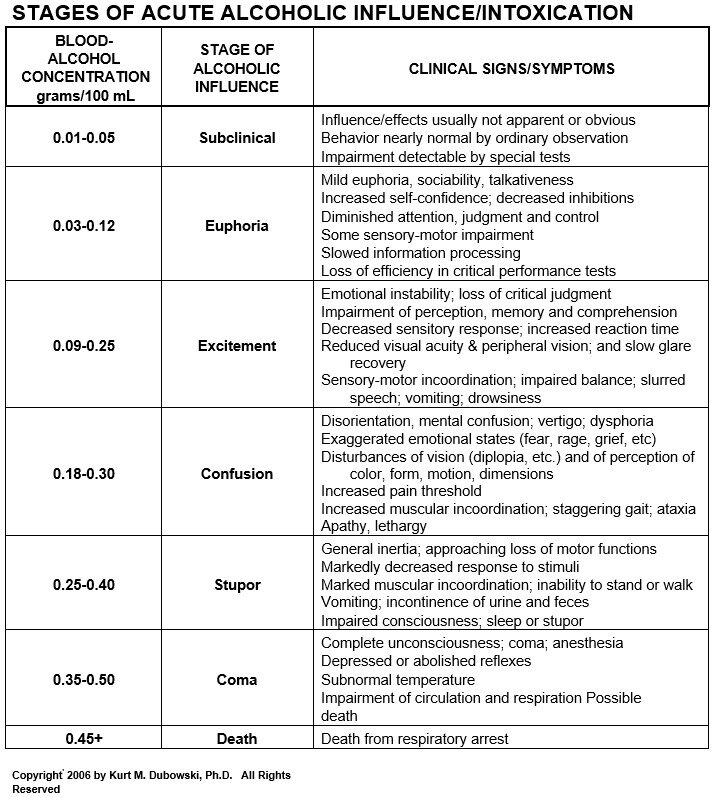
A common reference to a level of intoxication is .08 BAC which most people are familiar with concerning driving under the influence. As you can see from the chart, a person having a BAC of .09 is likely to experience impairment of perception, memory and comprehension, decreased sensory response, increased reaction time, reduced visual acuity & peripheral vision, slow glare recovery and sensory-motor incoordination. The question in the prosecution and defense of a sex assault charge is if the alleged victim reportedly had BAC of .09, was the individual incapable of consenting? Although the expert will be able to render an opinion as to the clinical signs and symptoms at the level of intoxication, the expert will not likely be permitted in court to render an opinion if that person was incapable of consenting due to the fact that it is an ultimate issue to be decided by the court members. However, if the expert had been able to render that opinion, it would likely be that NO – a person with a BAC of .09 was not incapable of consenting.
So the question that the court members have to determine is at what level of intoxication would the alleged victim be incapable of consenting? Looking at the chart, it would appear that at a level of .18 BAC, in the stage of CONFUSION, the alleged victim would likely be disoriented, with mental confusion, vertigo, exaggerated emotional states (fear, rage, grief, etc), disturbances of vision and of perception of color, form, motion, dimensions, increased muscular incoordination, apathy and lethargy. Is that individual incapable of consenting to sexual activity? What if the alleged victim was determined to be in the stage of STUPOR with a BAC of .25 or higher where the person would likely be experiencing approaching loss of motor functions, markedly decreased response to stimuli, marked muscular incoordination, inability to stand or walk, vomiting, incontinence of urine and feces with impaired consciousness involving sleep or stupor? Again this is an issue the court members have to determine.
As you can see, the determination by the court members as to if the alleged victim was capable or incapable of consenting is based upon a number of factors. As would be expected in a case of this nature, the alleged victim would likely assert on direct examination that he/she had ingested alcohol to the point of not knowing what was going on, and as a result was incapable of consenting to the subject sexual activity with the accused. To rebut that testimony, the defense attorney needs to establish that the members need to look beyond the testimony of the alleged victim. Effective cross-examination must be conducted, at all times having the expected opinions of the forensic toxicologist in mind, in an effort to undercut the prosecutions evidence. Failure of the defense attorney to fully address this issue can, and likely will result in a conviction for an Article 120 offense, resulting in a punitive discharge, confinement for a significant period of time and a life-time of sex offender registration.
Our client, a junior Navy officer entered a plea of Guilty in Federal District Court to one count of Possession of Child Pornography. The maximum punishment that our client was facing was imprisonment for 20 years, 5 years to life of supervised release and a $ 250,000 fine. Upon, upon our request, the Federal judge allowed our client to remain on Personal Recognizance Bond until his sentencing hearing which was scheduled for approximately three months later. The Pre-Sentence Report contained the Probation Officer’s assessment of the Federal Sentencing Guidelines which called for a sentence of imprisonment in the range of 78 to 97 months.
In our submission of the Defense Position with Respect to Sentencing Factors (referred to as Position Paper), we requested that the Court grant a significant downward variance from the applicable sentencing guidelines. Our position was that the Federal Sentencing Guidelines for child pornography offenses were outdated and did not take into account current factors that have been determined to be applicable in child pornography offenses. We argued that enhancement points for material involving prepubescent minors, sadistic or masochistic conduct, use of a computer, and number of images are applicable to conduct that is inherent to the underlying offense itself and should not be considered as aggravating factors warranting enhancement under the Guidelines. Our position was that if the Court were to consider the Guidelines, minus those aforementioned enhancements, the applicable Guideline range would be imprisonment in the range of 18 to 24 months of confinement, and that the appropriate sentence would still be well below that Guideline range. We also argued that our client readily accepted responsibility for his conduct when his home was searched by the FBI, as well as the fact that we had him in counseling since the search of his home. The Government argued for a sentence of imprisonment for 78 months which was the low end of the Guidelines.
In determining the appropriate sentence, the judge is obligated to impose a sentence which is “sufficient, but not greater than necessary” to serve the purposes of sentencing set forth under the applicable Federal criminal code. After consideration of our argument and sentencing package which highlighted our client’s exemplary military career, his otherwise outstanding background, his participation in counseling and his acceptance of responsibility, the judge imposed a sentence of confinement for 12 months and 1 day. This sentence was a significant downward departure from the Federal Sentencing Guidelines.
Since March of 2020, there has been a rapid shift in the criminal justice system in Virginia, desperately trying to keep up with and contain the impacts of COVID-19. More individuals who have been arrested for nonviolent offenses are being granted bond by the magistrate, and more defendants who were initially denied bond by the magistrate are being admitted to bail during bond hearings and bond appeals. Additionally, this tragic pandemic has presented opportunities for inmates to finish serving their sentences on home electronic confinement (“house arrest”) and other non-incarceration options.
At McCormack & McCormack, we know that when you or a loved one is incarcerated, even under ordinary circumstances, it can be a terrifying and desperate time. With the possibility for Coronavirus to spread through a jail like wildfire, it is more important than ever to try everything possible to get our clients out of jail, whether on pretrial release or reducing or modifying their sentence.
Since mid-March, there have been several orders handed down by the Supreme Court of Virginia and the local courts of Hampton Roads and throughout Virginia, which have mandated the continuance of all “non-emergency” matters. These matters include criminal preliminary hearings, motions hearings, and bench and jury trials. Currently, the closures extend through April 26, 2020, though we expect they may continue beyond that date. Falling under the umbrella of “emergency” matters, though, are hearings such as bond hearings and appeals, protective order hearings, and motions to reconsider sentences and bond denials. It is more important now than it has ever been to secure competent and aggressive representation to get you or your loved one out of jail as immediately as possible.
Several courts and jails throughout Greater Hampton Roads have begun releasing non-violent offenders on bond or early release, and many commonwealth attorney’s offices have softened their stance on instances which they might agree to a modification. Whether your loved one is in Accomack, Chesapeake, Hampton, Newport News, Norfolk, Northampton County, Portsmouth, Suffolk, Virginia Beach, Williamsburg/James City County, or York County, we can assist in their attempts to secure a bond or an early release.
The Attorneys at McCormack & McCormack, upon being retained to represent our client, will immediately contact the prosecutor assigned, or the clerk’s office, to discuss the possibility of an agreed-upon early release or bond. While we are unfortunately unable to visit clients face-to-face currently, we will immediately make contact with the client and discuss their situation. We will address all factors with them which might assist their position for early release or bond, such as: underlying health issues making them more at-risk; their age being a risk-factor; the nature of their charges or convictions (whether they are violent or non-violent); their family status outside of jail; and any other factors which would promote their release from confinement. If an agreement cannot be reached with the prosecutor, we will file the necessary motions for an emergency hearing, to be held as soon as possible.
Do not hesitate any longer. Call McCormack & McCormack 24/7 at (757) 463-7224, and unleash us on your case NOW!